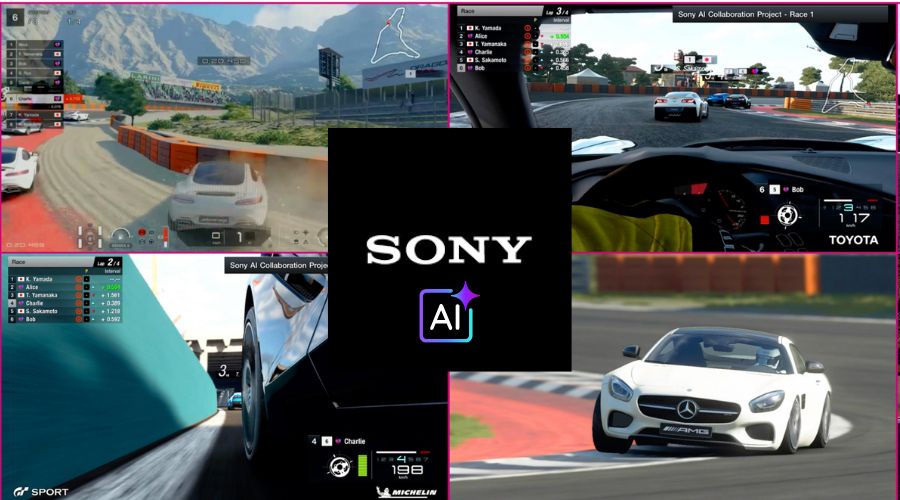
Back in 2020, Sony AI set a bold goal. They wanted to build an AI that could beat the world’s best Gran Turismo drivers. Not just compete with them, but actually beat them. By 2021, they had done it. That win was just the first step in Sony’s much bigger AI plan for gaming.
Sony has placed itself at the front of gaming’s AI revolution. Their approach stands out because it is not about replacing human creativity. Sony is firm on that point. Instead, they use machine learning in several areas. This includes racing agents that learn like humans, AI-powered upscaling tech, next-gen console architecture, and smart game development tools. Let’s look at what Sony Gaming AI actually is, how the technology works, and what it could mean for developers and players.
What is Sony Gaming AI?
Sony Gaming AI is a full set of AI technologies built to improve every part of interactive entertainment. Traditional game AI follows fixed scripts based on set rules. Sony’s approach is different. It uses something called deep reinforcement learning to build adaptive AI agents that learn through experience, much like humans do.
At its core, Sony’s AI philosophy is simple: AI should support creativity, not replace it. This idea shapes everything. It guides how their 50,000+ employees across 210 teams use the company’s Enterprise LLM platform. It also guides how AI gets built into PlayStation consoles and games.
The company works with legal, privacy, and ethics teams to set clear rules for AI use. They especially want to stop unauthorized copying of content. Sony also uses AI to protect creators’ work. They build systems that can spot content that has been stolen or misused.
Sony’s AI Approach: Beyond Rule-Based Systems
Traditional game AI runs on strict rules: “If the player does X, then the NPC does Y.” It’s predictable. Sony is changing game AI by using deep reinforcement learning to train AI agents in gaming worlds. This technology lets developers build richer experiences that can adapt, learn, and grow.
How reinforcement learning works in games
Reinforcement learning (RL) agents learn tasks through repeated practice in an environment. Think of it like teaching someone to drive. They practice again and again. They get feedback on their actions and slowly improve through trial and error.
Sony AI’s approach rewards good behavior and discourages bad actions. This lets the AI keep improving through repeated training. Modern video games need precise control and creative solutions, so they make ideal training grounds for these agents. The innovations built for gaming may also work in other real-world fields.
Gran Turismo Sophy: The Breakthrough AI Racing Agent
Racing AI explained
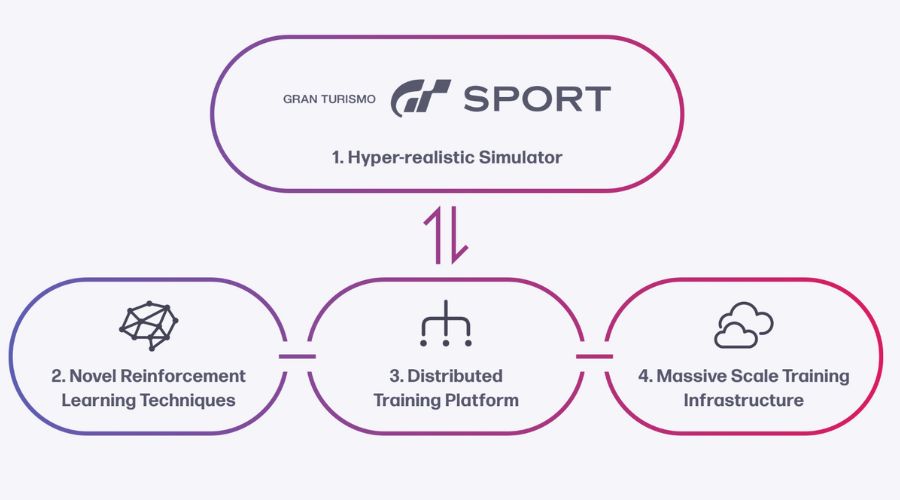
Gran Turismo Sophy (GT Sophy) is Sony’s most celebrated AI achievement. It is an autonomous racing agent that doesn’t just compete with the world’s best Gran Turismo drivers. It actually beats them, and it does so with racecraft that feels remarkably human.
It came from a unique team-up between Sony AI, Polyphony Digital, and Sony Interactive Entertainment. GT Sophy achieved what many people thought was impossible: superhuman racing skill combined with real sportsmanship.
The achievement was featured as a cover article in Nature in February 2022. It also won Sony AI the 2022 ACM SIGAI Industry Award for Excellence in Artificial Intelligence.
How GT Sophy learns to race
GT Sophy learns to race the same way professional drivers do: through lots of practice. The AI drives cars thousands of times on each track. It races against other cars to master proper on-track behavior and racecraft.
Instead of following pre-programmed racing lines, GT Sophy uses reinforcement learning to build an intuitive feel for the track:
- Contemplates overtaking opportunities rather than just executing scripted maneuvers
- Exhibits restraint when aggressive moves might cause accidents
- Adapts racing lines based on opponent positioning and race conditions
- Balances competitive drive with clean racing practices learned through reinforcement
This adaptive strategy creates racing behavior that feels truly human, not mechanical. GT Sophy doesn’t just follow the optimal path—it makes real-time strategic decisions based on how the race is unfolding.

Emotional intelligence on the track
Perhaps GT Sophy’s most remarkable feature is its emotional side. The AI uses visual “emojis” above its car to show its emotional state during races:
- Shows “sadness” when crashed into or overtaken
- Displays “happiness” when executing successful passes
- Audible chimes signal emotion changes
This shows GT Sophy’s deep grasp of racing psychology and competitive dynamics. It helps players connect with the AI as a racing rival, not just an algorithm.
Benefits of GT Sophy for players
Flexible training partner
The March 2025 release of GT Sophy 2.1 changed the AI from a superhuman opponent into a customizable training partner. Players now have more control over their racing experience than ever before:
- Choose from 19 car models and tracks
- Select number of laps and racing conditions
- Customize GT Sophy’s vehicles with upgrades and tuning specs
- Set tire and fuel consumption rates
- Adjust difficulty to match personal skill level
Enhanced racing skills
GT Sophy helps players improve their racing skills in these ways:
- Providing consistent, adaptive competition at any skill level
- Demonstrating proper racing etiquette and sportsmanship
- Creating opportunities to experiment with new strategies
- Offering challenging opponents that respond realistically to player tactics
Richer gaming experiences
GT Sophy shows that AI can create more engaging, dynamic gameplay. Most opponents are predictable, and players quickly learn to exploit them. GT Sophy is different. It keeps adapting, so every race feels fresh and competitive.
The Technology Behind GT Sophy
Multi-agent learning
Almost all video games involve dealing with other agents or humans, and the rules of engagement often are not clearly set. Without clear cost functions or access to every possible behavior, AI agents in games need to be tougher and more adjustable than in traditional AI fields.
GT Sophy interacts with multiple agents and human players at the same time. It learns to handle complex social dynamics on the track. Almost all real-world fields involve multiple agents too, such as self-driving cars and robotics. So the multi-agent learning methods Sony built for GT Sophy could apply well beyond gaming.
Scalable training infrastructure
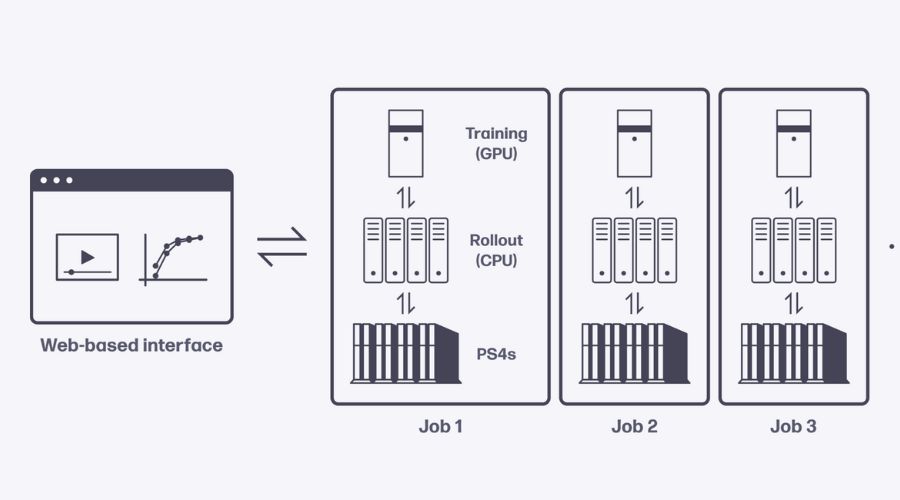
Modern reinforcement learning and AI algorithms need huge amounts of computing power and data. Sony AI built an advanced engineering system that provides:
- Large-scale compute resources for modern RL algorithms
- Rapid deployment of learning algorithms trained on video games at scale
- Trustworthy and repeatable RL processes for production environments
- Efficient training of AI agents across diverse gaming scenarios
This platform reflects years of research into building engineering systems made specifically for game AI training. It keeps evolving to support more advanced AI applications.
PlayStation Spectral Super Resolution (PSSR): AI-Powered Upscaling
What is PSSR?
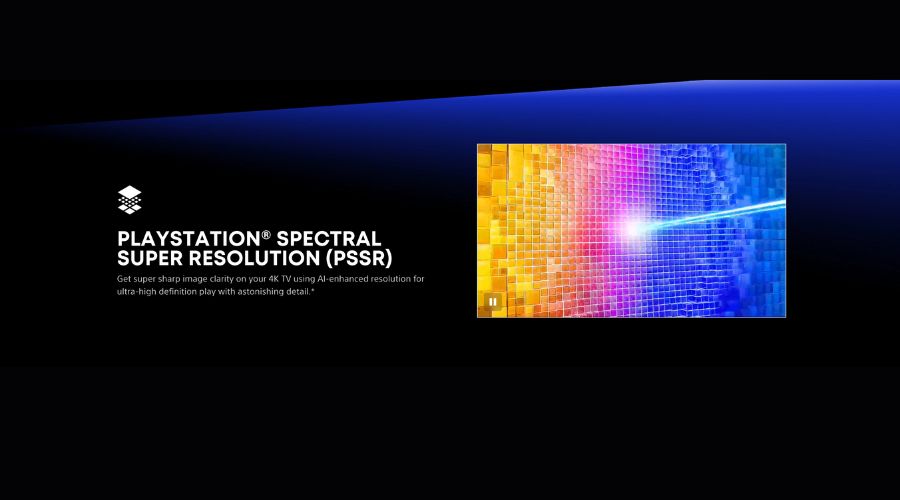
PlayStation Spectral Super Resolution (PSSR) is Sony’s AI rendering technology. It runs on dedicated machine learning processors on the PS5 Pro. PSSR launched in November 2024 as the first machine learning upscaler on home consoles. It brings technology once limited to high-end PC gaming to everyday players.
Like NVIDIA’s DLSS (deep learning super sampling) technology, PSSR relies on neural networks trained with high-resolution images. Machine learning teaches the network how to add and guess details in images. This creates sharp visuals from lower-resolution renders.
PSSR explained
PSSR lets games render at lower resolutions, such as 1080p Full HD or 1440p Quad HD. Then AI algorithms figure out what those images would look like at higher resolutions, like 2160p or 4K.
Images render at lower resolutions but look like they are running at much higher resolutions. This greatly cuts the workload for graphics processing units (GPUs). The result is better graphics performance and higher frame rates, plus sharp images that go beyond what native rendering can produce.
Mike Fitzgerald from Insomniac Games explains: “We can render at a lower resolution, bring it up to a full 4K, and get tons of extra detail out of the picture.”
How PSSR learns and improves
What sets PSSR apart from traditional upscaling is its ability to learn. Travis McIntosh from Naughty Dog highlights this: “[PSSR] produces just a way better result than previous upscalers because it can be trained not only on our game but on plenty of other games, and it learns and it improves at each iteration.”
The neural network behind PSSR trains across many games instead of being tuned for just one title. This cross-game learning lets PSSR do the following:
- Fix graphical errors and artifacting automatically
- Improve challenging elements like foliage rendering through specialized training
- Deliver better results over time as more developers implement the technology
- Adapt to various art styles and visual approaches
As the neural network keeps learning, the algorithm behind the technology gets better. This helps both developers who add PSSR to their games and gamers who enjoy the improved visuals.
Benefits of PSSR for Gamers and developers
Faster frame rates
Games that run at higher frames per second (fps) usually feel smoother and more responsive, though the ideal FPS depends on the game. Most games run well at 30 fps or more, while action-packed titles usually aim for 60 fps or higher.
PSSR can boost frame rates a lot. It delivers 4K visual quality while rendering at lower, less demanding resolutions. This frees up GPU resources for better performance.
Enhanced images
Running games at a higher fps can hurt visuals, causing stuttering or lag. PSSR helps fix this. It delivers sharper, enhanced image quality similar to what you’d expect at higher native resolutions.
For example, PSSR gives you the extra pixels and visual quality of 2160p (4K) imagery while actually rendering frames at a lower 1080p resolution. This keeps visual quality high without the usual performance cost.
Improved performance
Games running at higher settings can put heavy strain on graphics cards and hurt performance. Performance varies based on whether the GPU is running ray tracing, which game you're playing, and your hardware setup.
PSSR helps improve system performance even at higher settings. It does this by efficiently using machine learning processors, delivering far better results than older console upscaling methods.
PSSR vs. competing technologies
Digital Foundry ran extensive tests comparing PSSR against rival upscaling technologies using Ratchet & Clank: Rift Apart. They matched resolutions precisely for a fair comparison between PSSR, AMD FSR 3.1, and NVIDIA DLSS 3.7.
Results:
- PSSR significantly outperforms traditional console upscaling
- Approaches DLSS quality in many scenarios
- Particularly strong with complex visual elements and edge detail
For console gamers, PSSR marks a generational leap in visual quality without needing a matching jump in GPU power. It brings technology once available only to PC gamers with expensive graphics cards to everyone.
Project Amethyst: The Future of PlayStation Gaming
Sony and AMD’s next-generation collaboration
Project Amethyst is a major gaming technology partnership between Sony and AMD. Its goal is to define graphics architecture for PlayStation 6 and beyond. Development started in 2023, once PS5 Pro was mostly finished. The clear goal was to use AI and machine learning to improve game visuals and performance.
The codename Amethyst blends PlayStation blue with AMD red to create purple—a symbol of their shared vision for gaming’s future.
Mark Cerny’s vision for machine learning gaming
Mark Cerny, lead architect for PS5 and PS5 Pro, states: “Machine learning-based processing is the future.” The goal is “fewer pixels, prettier pixels coupled with machine learning libraries to increase resolution or add frames or assist in various ways with ray tracing.”
This marks a major shift in gaming hardware philosophy. It puts smart processing ahead of raw computing power.
Three Pillars of Project Amethyst
1. Neural Arrays (Performance)
Neural Arrays are a group of compute units linked together to work as one focused AI engine. They’re built to handle large machine learning workloads more efficiently than traditional GPU designs. This enables next-generation neural rendering, with dedicated hardware for AI upscaling, frame generation, and ray tracing enhancement. As a result, standard GPU cores carry a lighter computational load.
2. Radiance Cores (Immersion)
This is dedicated ray traversal hardware, built for high-performance real-time ray tracing and path tracing. Radiance Cores take heavy ray tracing tasks off shader cores. This frees the shader cores to work on other scene elements while delivering higher fps with immersive visuals. It makes photorealistic lighting and reflections possible on consoles, bringing visual quality once limited to expensive PC setups into mainstream gaming.
3. Universal Compression (Efficiency)
This is a compression system that checks and compresses all available data in the GPU, not just textures. It greatly cuts memory bandwidth use, unlocking new performance levels with better efficiency. It fixes a major bottleneck in modern GPU design.
Timeline and availability
AMD’s Jack Huynh revealed that the machine learning acceleration hardware they are co-engineering on RDNA 5 comes directly from the Sony partnership. This technology will show up in:
- RDNA 5 graphics cards: First public confirmation of AMD’s next GPU generation
- 2026-2027 launch window: Expected timeframe for next-generation consoles
- Cross-platform benefit: Technologies appearing in both PlayStation 6 and AMD Radeon graphics cards
FSR Redstone: Shared AI upscaling innovation
Sony and AMD co-developed a new AI upscaling algorithm that forms the base for AMD’s FSR Redstone, announced at Computex 2025. The algorithm moves from Convolutional Neural Networks (CNN) to Transformer Model architecture. It's built to create sharper upscaled images than current-generation technology.
Mark Cerny emphasizes interoperability: “There will be implementations of the algorithm as FSR and implementations of the algorithm as Spectral… But the fact is they will be extraordinarily close because we want the game developers to have interoperability.”
This approach helps developers, who can add similar AI upscaling across PC and console platforms without much extra work. Gamers benefit too, enjoying consistent quality no matter what hardware they use.
Frame generation coming to consoles
Project Amethyst’s next phase includes machine learning-based virtual frame generation—technology already on PC that is now coming to PS5 Pro and future consoles. AI creates entirely new frames and inserts them between rendered frames. This sharply increases frame rates without a matching rise in GPU load.
Cerny stresses player choice in this approach: “We can support a high frame rate by having a lower resolution render and more aggressive super resolution. We can also support a high frame rate by using frame generation. And once that choice is out there, Sony can learn more about what gamers want.”
AI in Game Development: Sony’s Internal Tools
AI-powered quality assurance
Sony has pioneered machine learning-based game testing that greatly improves QA speed and accuracy. This addresses growing worries about testing costs as games get bigger and more complex.
Dual agent QA system
Sony built two AI agents that work together for automated testing:
Replay Agent excels at repeating exact button combinations. It can navigate in-game menus and PS5 hardware menus, move characters from spawn points to level transitions, and test scenarios that need perfect consistency.
Imitation Agent adds variety that reflects real-world gameplay. It copies human-like play patterns with natural variation, uses machine learning models trained on human gameplay data, and adapts to changing game elements like enemy AI and camera control.
Case study: Astro’s Playroom
Sony showed off their AI QA system during Astro’s Playroom development. Human testers played each section 10 to 20 times to build sample data. Machine learning models learned from this gameplay data. After that, AI agents tested game sections on their own.
Benefits achieved:
- Significantly reduced testing time in many scenarios
- Earlier bug detection throughout the development cycle
- Improved overall game quality at release
Limitations:
- Some games require extensive training data for effective testing
- Changes in game parameters necessitate new ML models
- System still requires human oversight
Human-equivalent gameplay automation
At CEDEC 2024, Sony showed AI technology that lets AI play PS5 games on its own, under the same conditions a human player faces. The system uses only on-screen information. It combines imitation learning, controller recording and replay, and image recognition, switching models based on visual cues.
This automates PS5 system software function tests under real end-user conditions. It cuts QA costs and finds defects earlier in development, which matters more as testing needs grow alongside game complexity.
Additional AI Innovations
Predictive AI: Anticipating player actions
Sony filed a patent revealing AI that can predict a player’s next button press before it happens. The technology uses cameras to track player movements during gameplay. The AI learns to recognize patterns and predict upcoming inputs based on physical movements.
Potential benefits:
- Eliminates input lag by anticipating actions before execution
- Provides competitive advantages through split-second timing improvements
- Seamlessly handles internet disruptions by automatically completing interrupted commands
The predictive assistance system points to dedicated AI processors (Neural Processing Units) in future PlayStation consoles. These could enable faster ray tracing, improved performance modes, and real-time strategic tips that adapt during gameplay.
AI-powered NPCs: Interactive Aloy prototype
Sony’s Advanced Technology Group built an AI-powered version of Aloy from Horizon Forbidden West to show off conversational AI in gaming. The prototype combines OpenAI Whisper (speech-to-text), GPT-4 and Llama 3 (dialogue and decisions), Sony’s Voice Synthesis system, and Sony’s Mockingbird technology (audio-to-facial animation).
The demo showed Aloy responding to player voice prompts with AI-generated voice and realistic facial expressions. All of this ran on PS5 consoles with almost no performance hit. It remains an internal prototype not confirmed for public release. Still, it shows real possibilities: NPCs having natural language conversations, characters adapting dialogue based on player history, and voice interactions replacing traditional dialogue trees.
Content protection and enhancement
Sony uses AI to protect intellectual property. Their systems detect stolen or misused content and watch for unauthorized copying. AI also helps enhance media, including restoring old content and improving PS5 picture quality.

Supported Hardware and Future Integration
PSSR-supported consoles
PSSR is available on the PlayStation 5 Pro, which launched in November 2024. The technology uses dedicated machine learning processors built into the console’s custom GPU architecture. This enables AI upscaling in every game that supports the feature.
Expected features in PlayStation 6
Mark Cerny’s statement that “machine learning-based processing is the future” shows that AI will play a big role in next-generation consoles:
AI-native architecture: This includes an RDNA 5 GPU with dedicated neural processing units, Project Amethyst technologies (Neural Arrays, Radiance Cores, Universal Compression), and hardware built for AI workloads from the ground up.
Advanced upscaling and frame generation: This means an evolved PSSR with better algorithms, AI-generated frames that boost performance, and real-time ray tracing enhancement through machine learning.
Developer flexibility: This includes support for various AI models, including ChatGPT if developers choose it, interoperability between AMD FSR and PlayStation Spectral upscaling, and libraries focused on getting the most out of the hardware.
Player choice: Players can choose between aggressive upscaling or frame generation for high frame rates, use customizable AI assistant features, and get adaptive difficulty through AI analysis.
Games and Engines Supporting Sony AI Technologies
GT Sophy availability
Gran Turismo Sophy 2.1 is available in Gran Turismo 7’s Custom Race mode. It gives players more customization and control over their AI racing experiences than ever before.
PSSR-enabled games
A growing list of games supports PSSR on PS5 Pro. Major titles from Sony’s first-party studios and third-party developers are adding the technology. As more developers adopt PSSR, the neural network keeps learning and improving. This benefits every game that uses the upscaling system.
Sony AI: Mission and Responsible AI Principles
Organizational mission
Sony AI was founded in April 2020 to research AI and robotics within entertainment. Their mission statement captures the philosophy: “Unleash Human Imagination and Creativity with AI.”
Sony AI works with artists, makers, and creators around the world. They focus on six strategic challenges. These include building trustworthy sensing platforms, transforming how people interact with digital environments, leading with ethical AI, and finding where AI sparks new levels of creativity.
Core values
Sony has laid out clear principles that guide AI development:
- AI should augment human creativity, not replace it
- Ethical considerations must guide AI implementation
- Privacy and legal compliance are essential
- Creators’ intellectual property must be protected
- Transparency about AI benefits and limitations is necessary
The Future of Sony’s AI-Powered Gaming Vision
When Sony first developed its Gaming AI technologies, each application needed separate training and setup. That has changed. With projects like PSSR and the cross-platform FSR Redstone partnership, Sony now offers more general AI networks that work across many games and platforms.
As the neural networks behind Sony’s AI technologies keep learning, the algorithms that power them improve too. This helps developers who add these technologies to their games. It also helps gamers, who get faster frame rates, better imagery, richer AI interactions, and more immersive gaming experiences.
Sony’s broad AI strategy makes the company a leader in gaming innovation across many areas. This ranges from breakthrough achievements like Gran Turismo Sophy to practical uses in upscaling and quality assurance. The company’s investments are more than small improvements—they signal a real rethinking of how games get made, played, and experienced.
From AI racing agents that show superhuman skill while staying sportsmanlike, to upscaling technologies that deliver 4K visuals without 4K rendering costs, Sony is building an AI-powered gaming future that balances:
- Technological excellence: Best-in-class AI implementations pushing boundaries
- Human creativity: AI as an augmentation tool, not a replacement
- Ethical responsibility: Clear governance protecting creators and users
- Player enjoyment: Technology serving gameplay
The next generation of gaming is not just about more powerful hardware—it is about smarter hardware that learns, adapts, and enhances every part of the gaming experience. With technologies stretching into the late 2020s and partnerships defining future console architecture, Sony is not just taking part in gaming’s AI-powered future. They are actively shaping it.
About the Author
This article looks at Sony’s full approach to artificial intelligence in gaming. It covers breakthrough technologies like Gran Turismo Sophy, PlayStation Spectral Super Resolution, and Project Amethyst, all of which are reshaping interactive entertainment for the next generation.