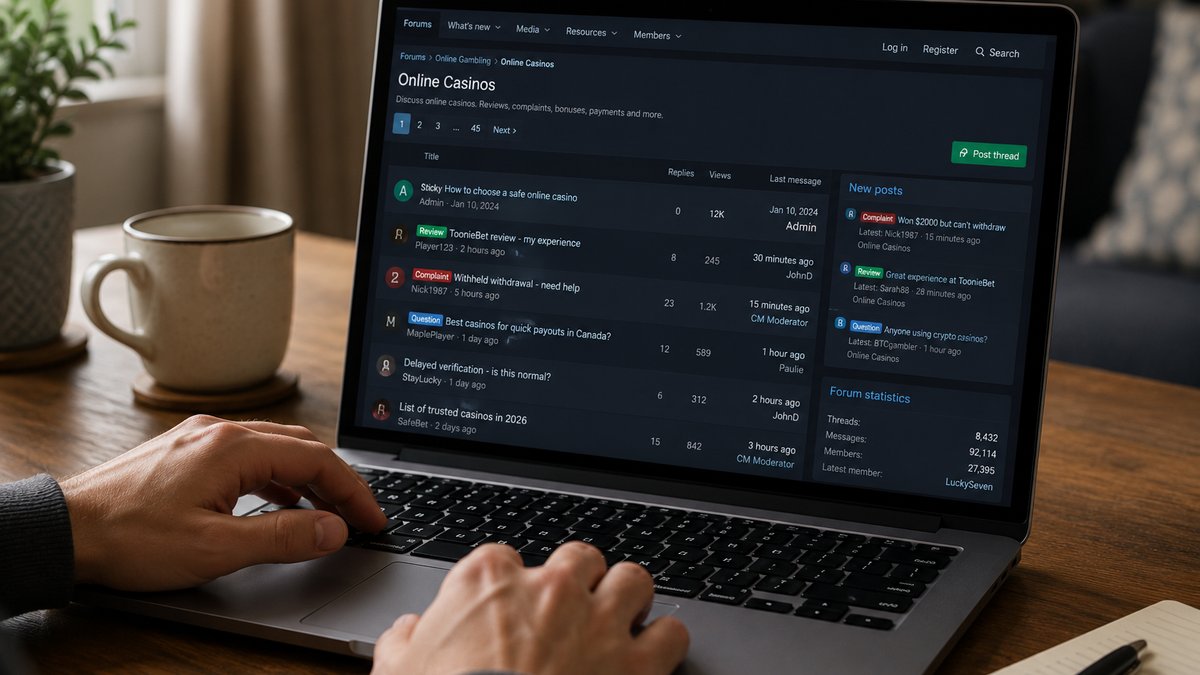
When the first online casinos launched in the 1990s, the Canadian gaming scene looked like the infamous Wild West. Standards were inconsistent, payment processing was unreliable, and a licence did not always mean meaningful oversight. Reports of withheld payouts and abrupt site closures were common enough during that period that they became a recurring topic on the earliest gambling message boards.
Out of this regulatory vacuum emerged an unexpected watchdog force: the players themselves. Players started going to forums and chat rooms to report delayed withdrawals, expose misleading bonuses and warn others about rogue operators. Over the years, these communities have gone from simple discussion boards to unofficial watchdogs that operators pay attention to.
Dedicated forums such as Casinomeister and AskGamblers, alongside general review platforms like Trustpilot and a number of Reddit communities, now function as an informal accountability layer. And in this article, we will look into how these platforms earned that influence.
The Role of Player Forums in Online Casino Gaming
A standard Tooniebet review will document the size of the game library, the payment methods supported, and the licensing details. What it cannot capture is how the platform behaves over time — how long a withdrawal actually takes, or how support responds when something goes wrong. That is where player forums come in.
A player forum is an online community where gaming enthusiasts share their experiences at online casinos with each other. They ask and answer questions about operator reputation, games, payment processing, bonuses, and of course, raise complaints. Here, you’ll find warnings from other players about casinos with verification issues, delayed withdrawals, unclear bonus terms, etc.
Why Operators Can’t Ignore Player Forums
Let’s face it – operators are in the market to make money, and they can’t do that without customer acquisition. Player forums have proven to be capable of becoming a stumbling block to this. Imagine that a player complained about winning $2,000 in an online casino but was unable to withdraw it. And then another responded, “the same happened to me last week but with a $5,000 payout.” Then more and more people report having a similar experience.
In the eyes of potential players, these complaints are no longer isolated incidents but an observable pattern of behavior that can negatively impact their own experience. Any player seeing this will naturally avoid such a casino. And the worst part is that negative threads like this can easily spread beyond the forum itself, reaching more potential customers. This can easily damage the casino’s reputation, which is a valuable asset in today’s iGaming industry.
Plus, some forums even have a “blacklist” section filled with casinos that they advise players to completely avoid. As such, operators are paying more attention and doing their best to resolve legitimate public complaints.
The Rise of Public Casino Complaint Systems
Over the years, the player forum role has become more formalized in the iGaming scene. Many forums don’t just simply allow public accusations. They ask players for evidence with screenshots to ensure the accusation is not unfounded. In fact, some of these platforms are now acting in dispute resolution roles. Casinomeister's Pitch-A-Bitch (PAB) service and the AskGamblers Casino Complaint Service both operate as mediation channels between players and operators, with published case outcomes.
While they don’t have the pull of official regulatory bodies, these unofficial watchdogs bank on reputation to influence casino operators. After all, casino operators understand that unaddressed complaints can negatively affect how potential players see their platforms. So they usually cooperate in addressing legitimate complaints. With this, the player potentially gets a resolution, the casino gains a reputation for fairness and accountability, and the forum gets credibility.
Beyond the Complaint: Information Sharing Among Players
Another thing about player forums is that they often act as informational hubs for players, especially newbies. If you’ve been playing at online casinos for some time, you will agree that some important details are hidden deep within the fine print. For example, an online casino may have unrealistic maximum win caps on bonuses, unexpected fees, and obscure clauses that can confiscate bonus funds anytime. You can usually find such information on player forums, making them early warning systems for the iGaming community.
The Dark Side of the Power of Unofficial Watchdogs
The role of unofficial online casino watchdogs is not without a few flaws. Its biggest problem has always been the prevalence of one-sided narratives. A player may omit their own fault when making complaints, such as bonus violations or multiple account activities. Such a narrative can impact a casino’s reputation even when it is not truly at fault.
Forum moderators have periodically raised concerns about coordinated posting, where negative claims appear in clusters that do not match organic user behaviour. Attribution in these cases is rarely conclusive. Also, communities have been known to amplify accusations without solid evidence. Lastly, there is also the possibility of moderator bias. In today’s affiliate-based gaming scene, conflicts of interest may reduce transparency.
Conclusion
Individually these posts are unreliable. Collectively, checked against evidence and sustained over years, they reveal a pattern that is harder to dismiss.
None of this replaces formal oversight. Players with an unresolved dispute in a regulated market should escalate through the operator's official complaints process and, if needed, the regulator's dispute-resolution channel. Anyone who feels their play is no longer under control can contact ConnexOntario, which operates a free 24/7 helpline.
The bottom line is that, due to how they can impact reputation, operators today pay attention to what you say in these communities. And this provides collective pressure that enforces accountability, transparency, fairness and dispute resolution. While player forums are not regulators, they can be a valuable and powerful alternative.