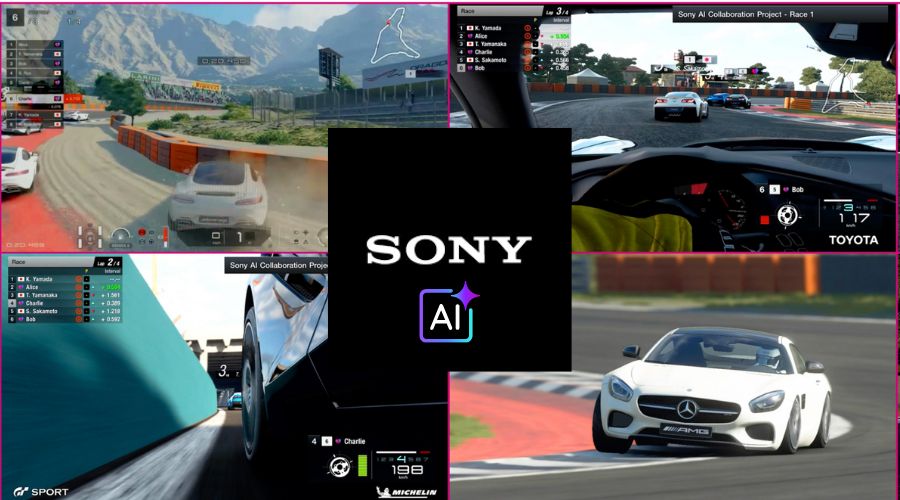
早在2020年,索尼AI决定挑战一件相当大胆的事情:打造一个能够真正击败世界上最好的《Gran Turismo》车手的AI。不仅仅是与他们竞争,而是击败他们。到2021年,他们做到了。但这一突破实际上只是索尼更大游戏AI愿景的开端。
索尼在游戏AI革命中处于前沿。他们的方法很有趣,因为这不是为了取代人类的创造力,他们对此非常坚持。相反,他们在多个领域利用机器学习:像人类一样学习的赛车代理、AI驱动的升级技术、下一代游戏机架构和智能游戏开发工具。让我们深入了解索尼游戏AI到底是什么,这项技术如何运作,以及它对开发者和玩家可能意味着什么。
What is Sony Gaming AI?
Sony Gaming AI is a comprehensive ecosystem of AI technologies meant to enhance every aspect of interactive entertainment. Unlike traditional rule-based game AI that follows predetermined scripts, Sony’s approach uses something called deep reinforcement learning to create adaptive AI agents that actually learn through experience, much like humans do.
At its core, Sony’s AI philosophy is straightforward: AI should augment creativity, not replace it. That principle guides everything from how their 50,000+ employees across 210 teams use the company’s Enterprise LLM platform to how AI gets integrated into PlayStation consoles and games.
公司与专注于法律、隐私和伦理的团队合作,建立AI使用的明确指南。他们特别关注防止未经授权的内容复制。索尼还通过建立能够检测被盗或不当使用内容的系统来保护创作者的作品。
索尼的AI方法:超越基于规则的系统
Traditional game AI operates on rigid rules: “If player does X, then NPC does Y.” It’s predictable. Sony’s transforming Game-AI by using deep reinforcement learning to train AI agents in gaming ecosystems. This technology enables developers to design and deliver richer experiences that can adapt, learn, and evolve.
How reinforcement learning works in games
强化学习(RL)代理通过在环境中反复练习来学习任务。可以把它想象成教人开车:他们反复练习,获得对其行为的反馈,并通过试错逐渐改进。
索尼AI的方法奖励积极行为并惩罚不良行为,这使得AI能够通过迭代训练不断改进。现代电子游戏需要精确的控制和创造性的解决方案,为这些代理提供了理想的训练场所。为游戏开发的创新也可能适用于其他现实世界领域。
Gran Turismo Sophy: The Breakthrough AI Racing Agent
Racing AI explained
Gran Turismo Sophy (GT Sophy) represents Sony’s most celebrated AI achievement. An autonomous racing agent that doesn’t just compete with the world’s best Gran Turismo drivers but actually beats them while demonstrating remarkably human-like racecraft.
It came out of a unique collaboration between Sony AI, Polyphony Digital, and Sony Interactive Entertainment. GT Sophy achieved what many thought was impossible: superhuman racing performance combined with genuine sportsmanship.
The achievement earned recognition as a cover article in Nature in February 2022. It also won Sony AI the 2022 ACM SIGAI Industry Award for Excellence in Artificial Intelligence.
How GT Sophy learns to race
GT Sophy learns racing the same way professional drivers do: through extensive practice. The AI drives cars thousands of times on each track, racing against other vehicles to master proper on-track behavior and racecraft.
GT Sophy使用强化学习来发展直观的理解,而不是遵循预编程的赛车路线:
- Contemplates overtaking opportunities rather than just executing scripted maneuvers
- Exhibits restraint when aggressive moves might cause accidents
- Adapts racing lines based on opponent positioning and race conditions
- Balances competitive drive with clean racing practices learned through reinforcement
This adaptive strategy produces racing behavior that feels genuinely human rather than mechanical. GT Sophy doesn’t just follow the optimal path—it makes real-time strategic decisions based on how the race is evolving.

Emotional intelligence on the track
Perhaps GT Sophy’s most remarkable feature is its emotional dimension. The AI uses visual “emojis” displayed above its car to communicate emotional state during races:
- 在被撞或被超越时显示“悲伤”
- 在成功超车时显示“快乐”
- Audible chimes signal emotion changes
这反映了GT Sophy对赛车心理学和竞争动态的复杂理解。它帮助玩家将AI视为赛车对手,而不仅仅是一个算法。
Benefits of GT Sophy for players
Flexible training partner
The March 2025 release of GT Sophy 2.1 transformed the AI from a superhuman opponent into customizable training partner. Players now have unprecedented control over their racing experience:
- Choose from 19 car models and tracks
- Select number of laps and racing conditions
- 使用升级和调校规格定制GT Sophy的车辆
- Set tire and fuel consumption rates
- Adjust difficulty to match personal skill level
Enhanced racing skills
GT Sophy helps players advance their racing abilities by:
- 在任何技能水平上提供一致的、适应性的竞争
- Demonstrating proper racing etiquette and sportsmanship
- Creating opportunities to experiment with new strategies
- Offering challenging opponents that respond realistically to player tactics
Richer gaming experiences
GT Sophy展示了AI可以创造更具吸引力和动态的游戏玩法。与其让玩家快速学习如何利用的可预测对手,GT Sophy不断适应,使每场比赛都感觉新鲜和充满竞争。
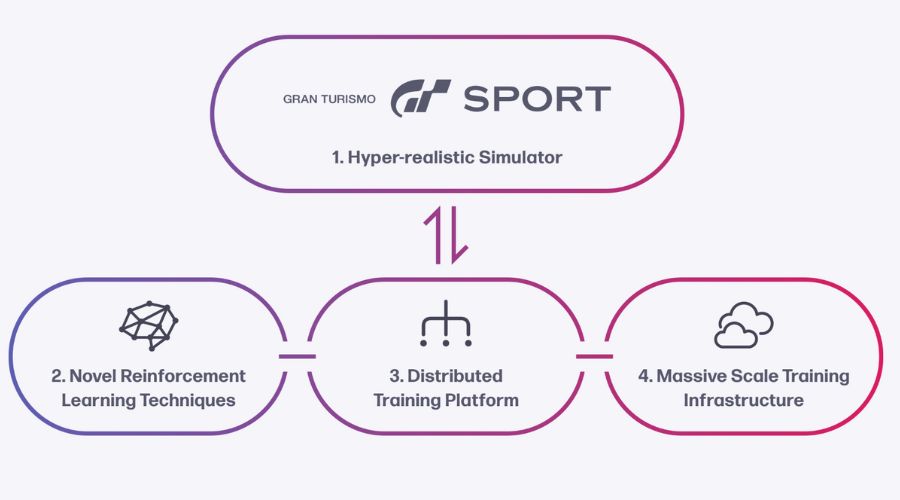
The Technology Behind GT Sophy
多代理学习
Almost all video games involve dealing with other agents or humans, and the rules of engagement often aren’t formalized. Without well-specified cost functions or access to all possible behaviors, AI agents in games need to be more robust and tunable than in traditional AI domains.
GT Sophy同时与多个代理和人类玩家互动,学习在赛道上驾驭复杂的社交动态。由于几乎所有现实世界的领域都涉及多个代理,例如自动驾驶汽车和机器人,索尼为GT Sophy开发的多代理学习技术可以广泛应用于游戏之外的领域。
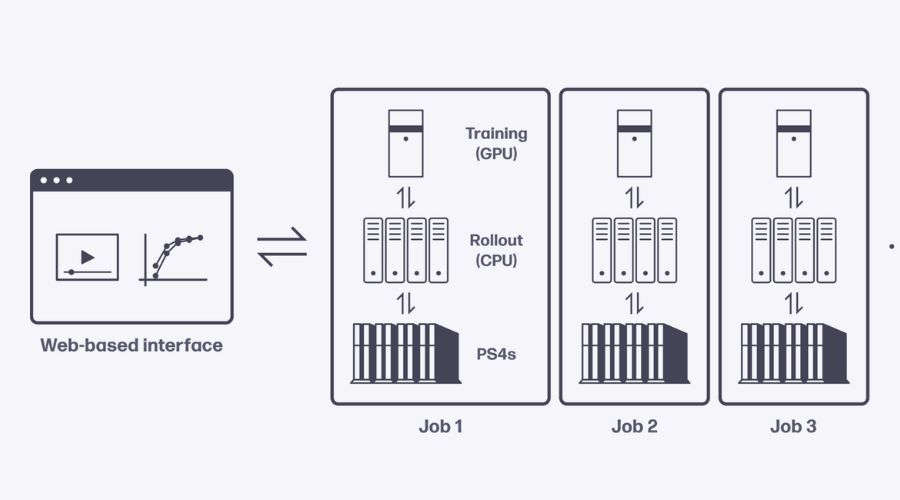
Scalable training infrastructure
Modern reinforcement learning and AI algorithms require massive compute and data resources. Sony AI developed a sophisticated engineering ecosystem that enables:
- 现代 RL 算法的大规模计算资源
- Rapid deployment of learning algorithms trained on video games at scale
- Trustworthy and repeatable RL processes for production environments
- Efficient training of AI agents across diverse gaming scenarios
该平台代表了多年来在构建专门为游戏 AI 训练设计的工程生态系统方面的研究,并继续发展以支持日益复杂的 AI 应用。
PlayStation Spectral Super Resolution (PSSR):AI驱动的升级技术
What is PSSR?
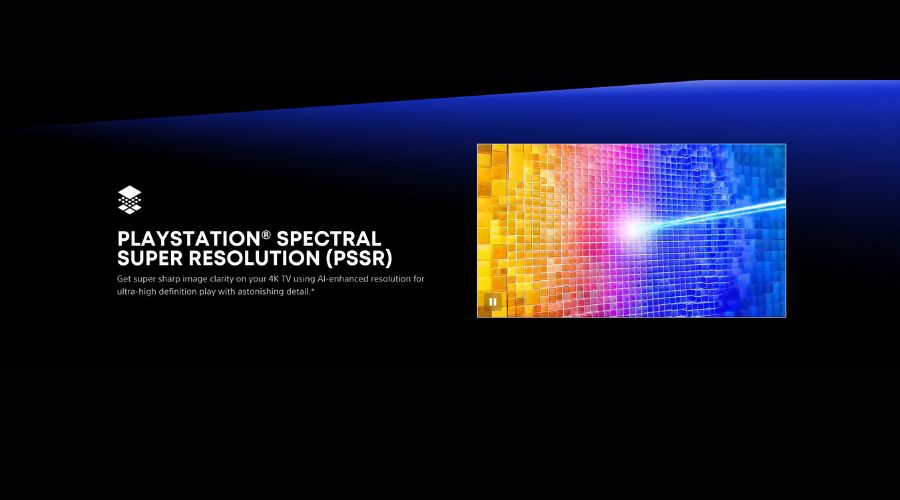
PlayStation Spectral Super Resolution (PSSR) is Sony’s AI rendering technology powered by dedicated machine learning processors on the PS5 Pro. Debuting in November 2024, PSSR represents the first machine learning upscaler implemented on home consoles, bringing technology that was previously exclusive to high-end PC gaming to mainstream audiences.
Similar to NVIDIA’s DLSS (deep learning super sampling) technology, PSSR taps into neural networks trained with high-resolution images. Machine learning teaches the network how to add in and infer details about images, creating sharp visuals from lower-resolution renders.
PSSR explained
PSSR允许游戏以较低分辨率(如1080p全高清或1440p四高清)渲染,然后使用AI算法确定这些图像在更高分辨率(如2160p或4K)下的外观。
图像以较低分辨率渲染,但给人一种它们在更高分辨率下运行的印象。这大大减少了图形处理单元(GPU)需要做的工作,从而提高了图形性能和帧率,同时生成超越原生渲染能力的清晰图像。
Mike Fitzgerald from Insomniac Games explains: “We can render at a lower resolution, bring it up to a full 4K, and get tons of extra detail out of the picture.”
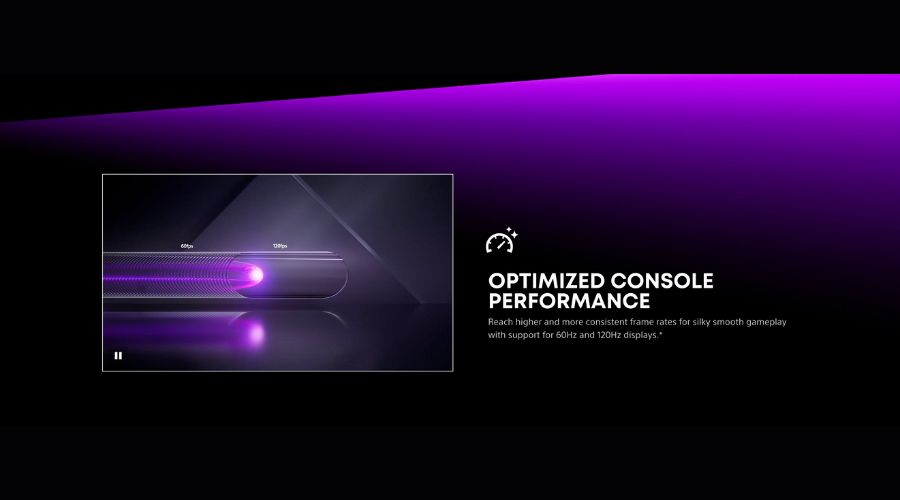
How PSSR learns and improves
What distinguishes PSSR from traditional upscaling is its learning capability. Travis McIntosh from Naughty Dog highlights this: “[PSSR] produces just a way better result than previous upscalers because it can be trained not only on our game but on plenty of other games, and it learns and it improves at each iteration.”
PSSR背后的神经网络在多个游戏中进行训练,而不是针对单个游戏进行优化。这种跨游戏学习使PSSR能够:
- Fix graphical errors and artifacting automatically
- Improve challenging elements like foliage rendering through specialized training
- Deliver better results over time as more developers implement the technology
- Adapt to various art styles and visual approaches
随着神经网络的持续学习,驱动技术的算法得到改进,惠及整合PSSR的开发者和体验增强图像的玩家。
Benefits of PSSR for Gamers and developers
Faster frame rates
以更高每秒帧数(fps)运行的游戏通常表现更好更快,尽管所需的FPS因游戏需求而异。大多数游戏在至少30 fps下表现理想,而动作丰富的游戏通常以60 fps或更高为目标。
PSSR通过在要求较低的分辨率下渲染来大幅加速帧率,同时实现4K视觉质量,释放GPU资源以获得更高性能。
Enhanced images
在更高fps下运行游戏可能会影响视觉效果,导致卡顿或延迟。PSSR有助于抵消这一点,提供增强和更清晰的图像质量,媲美您在更高原生分辨率下的期望。
例如,PSSR提供了2160p(4K)图像的额外像素和视觉输出,而实际上以较低功率的1080p分辨率渲染帧,保持视觉保真度而不增加性能成本。
Improved performance
在更高设置下运行的游戏可能会显著消耗显卡并影响性能。性能因GPU是否运行光线追踪、所玩的特定游戏以及硬件配置而异。
PSSR helps improve system performance even when running at higher settings by efficiently using machine learning processors to deliver dramatically better results than previous console upscaling methods.
PSSR vs. competing technologies
Digital Foundry conducted extensive testing comparing PSSR against competing upscaling technologies using Ratchet & Clank: Rift Apart, matching resolutions precisely to ensure accurate comparison between PSSR, AMD FSR 3.1, and NVIDIA DLSS 3.7.
Results:
- PSSR significantly outperforms traditional console upscaling
- Approaches DLSS quality in many scenarios
- Particularly strong with complex visual elements and edge detail
对于主机玩家来说,PSSR代表了视觉质量的代际飞跃,而无需成比例地增加GPU功率,使以前仅限于PC玩家的昂贵显卡技术普及化。
Project Amethyst: The Future of PlayStation Gaming
索尼和AMD的下一代合作
Project Amethyst represents a significant gaming technology partnership between Sony and AMD aimed at defining graphics architecture for PlayStation 6 and beyond. Development began in 2023 when PS5 Pro was largely complete, with the explicit goal of using AI and machine learning to improve game visuals and performance.
The codename Amethyst combines PlayStation blue with AMD red, creating purple—a symbol of their unified vision for gaming’s future.
Mark Cerny对机器学习游戏的愿景
Mark Cerny, lead architect for PS5 and PS5 Pro, states: “Machine learning-based processing is the future.” The goal is “fewer pixels, prettier pixels coupled with machine learning libraries to increase resolution or add frames or assist in various ways with ray tracing.”
这代表了游戏硬件哲学的根本转变,优先考虑智能处理而不是蛮力计算。
Three Pillars of Project Amethyst
1. Neural Arrays (Performance)
Neural Arrays represent a collection of compute units connected to function as a single, focused AI engine. They’re designed to be more efficient for large machine learning workloads than traditional GPU designs, enabling next-generation neural rendering with dedicated hardware for AI upscaling, frame generation, and ray tracing enhancement that reduces computational burden on standard GPU cores.
2. Radiance Cores (Immersion)
Dedicated ray traversal hardware designed for high-performance real-time ray tracing and path tracing. Radiance Cores offload intensive ray tracing tasks from shader cores, freeing them to work on other scene elements while delivering higher fps with immersive visuals. This makes photorealistic lighting and reflections computationally feasible for consoles, bringing visual quality previously limited to expensive PC setups to mainstream gaming.
3. Universal Compression (Efficiency)
A compression system that evaluates and compresses all available data within the GPU, not just textures. This dramatically reduces memory bandwidth usage, enabling new performance levels with greater efficiency. It addresses a critical bottleneck in modern GPU design.
Timeline and availability
AMD’s Jack Huynh revealed that the machine learning acceleration hardware they’re co-engineering on RDNA 5 directly results from the Sony collaboration. This technology will appear in:
- RDNA 5显卡:AMD下一代GPU的首次公开确认
- 2026-2027发布窗口:下一代游戏机的预期时间框架
- 跨平台优势:技术同时出现在PlayStation 6和AMD Radeon显卡中
FSR Redstone: Shared AI upscaling innovation
Sony and AMD co-developed a new AI upscaling algorithm that serves as the foundation for AMD’s FSR Redstone, announced at Computex 2025. The algorithm shifts from Convolutional Neural Networks (CNN) to Transformer Model architecture, designed to create sharper upscaled images than current generation technology.
Mark Cerny emphasizes interoperability: “There will be implementations of the algorithm as FSR and implementations of the algorithm as Spectral… But the fact is they will be extraordinarily close because we want the game developers to have interoperability.”
这种方法使开发者受益,他们可以在PC和游戏机平台上实现类似的AI升级,而无需额外的工作量,同时玩家无论硬件如何都能享受一致的质量。
Frame generation coming to consoles
Project Amethyst’s next phase includes machine learning-based virtual frame generation—technology currently available on PC coming to PS5 Pro and future consoles. AI creates entirely new frames that get inserted between rendered frames, dramatically increasing frame rates without proportional GPU load.
Cerny强调在此实现中的玩家选择:“我们可以通过降低分辨率渲染和更激进的超分辨率来支持高帧率。我们也可以通过使用帧生成来支持高帧率。一旦这种选择出现,索尼就可以更多地了解玩家的需求。”
游戏开发中的AI:索尼的内部工具
AI 驱动的质量保证
Sony has pioneered machine learning-based game testing that dramatically improves QA efficiency and accuracy, addressing growing concerns about testing costs as games become larger and more complex.
Dual agent QA system
Sony developed two complementary AI agents for automated testing:
Replay Agent excels at replicating exact button combinations. It can navigate in-game UI and PS5 hardware menus, move characters from spawn points to level transitions, and test scenarios requiring perfect consistency.
Imitation Agent introduces variability reflecting real-world gameplay. It reproduces human-like play patterns with natural variance, uses machine learning models trained on human gameplay data, and adapts to dynamic game elements like enemy AI and camera control.
案例研究:Astro’s Playroom
Sony showcased their AI QA system through Astro’s Playroom development. Human testers played each section 10-20 times to create representative samples. Machine learning models learned from this gameplay data, after which AI agents autonomously tested game sections.
Benefits achieved:
- Significantly reduced testing time in many scenarios
- Earlier bug detection throughout the development cycle
- Improved overall game quality at release
Limitations:
- Some games require extensive training data for effective testing
- Changes in game parameters necessitate new ML models
- System still requires human oversight
人类等效游戏自动化
At CEDEC 2024, Sony presented AI technology enabling autonomous gameplay on PS5 that replicates human-player conditions. The system uses only on-screen information, combining imitation learning, controller operation recording/replay, and image recognition with model switching based on visual cues.
这自动化了在最终用户条件下的 PS5 系统软件功能测试,降低了 QA 成本,并在开发早期识别缺陷——这在测试需求随着游戏复杂性增长的情况下尤为重要。
Additional AI Innovations
Predictive AI: Anticipating player actions
Sony filed a patent revealing AI capable of predicting players’ next button press before it happens. The technology uses cameras to monitor player movements during gameplay, with AI learning to recognize patterns and predict upcoming inputs based on physical movements.
Potential benefits:
- Eliminates input lag by anticipating actions before execution
- 通过毫秒级的时机改进提供竞争优势
- Seamlessly handles internet disruptions by automatically completing interrupted commands
The predictive assistance system suggests dedicated AI processors (Neural Processing Units) in future PlayStation consoles, potentially enabling accelerated ray tracing, improved performance modes, and real-time strategic tips offered adaptively during gameplay.
AI 驱动的 NPC:互动 Aloy 原型
Sony’s Advanced Technology Group created an AI-powered version of Aloy from Horizon Forbidden West that demonstrates conversational AI in gaming. The prototype combines OpenAI Whisper (speech-to-text), GPT-4 and Llama 3 (dialogue and decisions), Sony’s Voice Synthesis system, and Sony’s Mockingbird technology (audio-to-facial animation).
The demonstration showcased Aloy responding to player voice prompts with AI-generated voice and realistic facial expressions, all tested on PS5 consoles with minimal performance impact. While it remains an internal prototype not confirmed for public release, it demonstrates possibilities for NPCs engaging in natural language conversations, characters adapting dialogue based on player history, and voice interactions replacing traditional dialogue trees.
Content protection and enhancement
索尼通过 AI 保护知识产权,系统检测内容是否被盗用或不当使用,并监控未经授权的复制。AI 应用还扩展到媒体增强,包括遗留内容恢复和 PS5 图像质量改进。

Supported Hardware and Future Integration
支持 PSSR 的游戏机
PSSR在2024年11月发布的PlayStation 5 Pro上可用。该技术利用集成到游戏机定制GPU架构中的专用机器学习处理器,实现所有实施该功能的游戏的AI升级。
Expected features in PlayStation 6
Mark Cerny’s statement that “machine learning-based processing is the future” indicates AI will play a major role in next-generation consoles:
AI-native architecture: RDNA 5 GPU with dedicated neural processing units, Project Amethyst technologies (Neural Arrays, Radiance Cores, Universal Compression), and hardware designed for AI workloads from the ground up.
高级升级和帧生成:PSSR的演变伴随着改进的算法,AI生成的帧提升性能,以及通过机器学习的实时光线追踪增强。
开发者灵活性:支持包括ChatGPT(如果开发者选择)的各种AI模型,AMD FSR和PlayStation Spectral升级之间的互操作性,以及专注于最大化硬件能力的库。
玩家选择:在高帧率下选择激进的升级或帧生成,自定义AI助手功能,以及通过AI分析的自适应难度。
Games and Engines Supporting Sony AI Technologies
GT Sophy availability
Gran Turismo Sophy 2.1 is available in Gran Turismo 7’s Custom Race mode, offering players unprecedented customization and control over their AI racing experiences.
支持 PSSR 的游戏
不断扩展的游戏库支持PS5 Pro上的PSSR。索尼第一方工作室和第三方开发者的主要作品正在实施这项技术。随着更多开发者采用PSSR,神经网络继续学习和改进,惠及所有使用该升级系统的游戏。
Sony AI: Mission and Responsible AI Principles
Organizational mission
Sony AI was established in April 2020 to pursue research in AI and robotics within entertainment. Their mission statement captures the philosophy: “Unleash Human Imagination and Creativity with AI.”
索尼 AI 与全球的艺术家、创作者和制作者合作,专注于六大战略挑战,包括开发可信的传感平台、改变数字环境互动、以道德 AI 为先导,并发现 AI 激发前所未有的创造力的领域。
Core values
Sony has articulated clear principles governing AI development:
- AI 应该增强人类的创造力,而不是取代它
- Ethical considerations must guide AI implementation
- Privacy and legal compliance are essential
- 创作者的知识产权必须得到保护
- Transparency about AI benefits and limitations is necessary
索尼AI驱动的游戏愿景的未来
当索尼游戏AI技术首次开发时,每个应用程序都需要单独的训练和实施。现在,通过像PSSR和跨平台FSR Redstone合作这样的项目,索尼提供了更通用的AI网络,可以在多个游戏和平台上工作。
随着索尼AI技术背后的神经网络不断学习,驱动它们的算法也在改进。这使得在游戏中实施这些技术的开发者和体验更快帧率、增强图像、更丰富AI互动和更沉浸式游戏体验的玩家受益。
索尼的全面AI战略将公司定位为跨多个维度的游戏创新领导者,从突破性成就如Gran Turismo Sophy到在升级和质量保证中的实际应用。公司的投资不仅仅代表增量改进——它们标志着对游戏创建、玩耍和体验方式的根本性重新构想。
从展示超人技能同时保持体育精神的AI赛车代理到提供4K视觉效果而无需4K渲染成本的升级技术,索尼正在构建一个平衡的AI驱动游戏未来:
- 技术卓越:顶级AI实现推动边界
- 人类创造力:AI作为增强工具,而非替代品
- Ethical responsibility: Clear governance protecting creators and users
- Player enjoyment: Technology serving gameplay
下一代游戏不仅仅是关于更强大的硬件——它是关于更智能的硬件,能够学习、适应并增强游戏体验的各个方面。随着技术延伸到2020年代后期以及定义未来游戏机架构的合作伙伴关系,索尼不仅仅是在参与游戏的AI驱动未来;他们正在积极塑造它。
关于作者本文探讨了索尼在游戏中对人工智能的全面方法,研究了如Gran Turismo Sophy、PlayStation Spectral Super Resolution和Project Amethyst等突破性技术,这些技术正在为下一代重塑互动娱乐。
